What Should I Do After My Property Gets Hit by Hail?
February 21, 2026

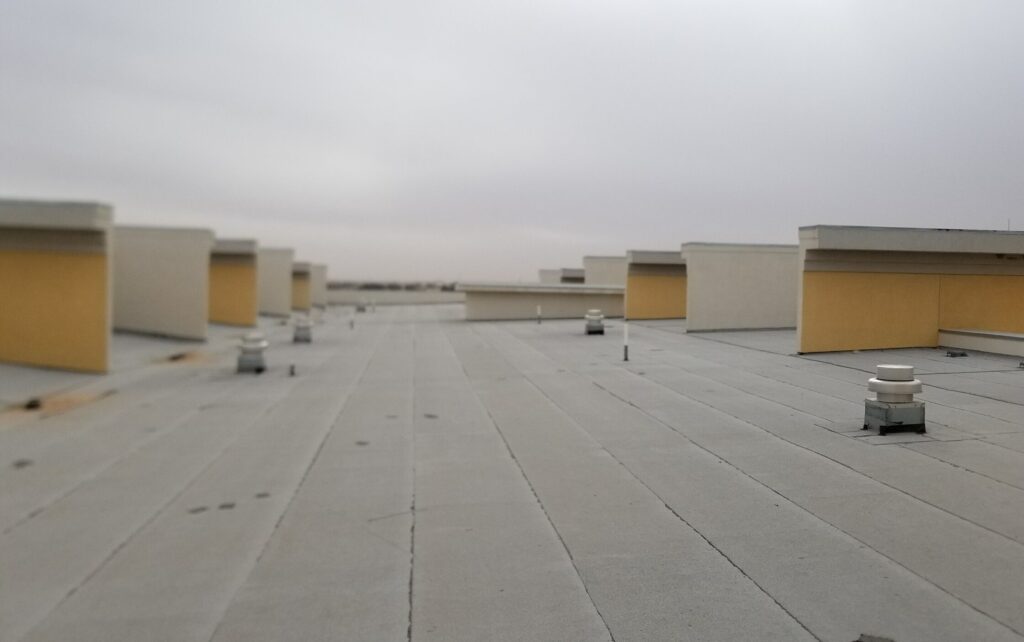
If you manage a commercial building in North Texas, you’ve likely heard “TPO” mentioned as the gold standard for flat or low-slope roofing. In an environment where July temperatures routinely shatter the 100°F mark and spring “supercells” bring golf-ball-sized hail to Weatherford, Aledo, and Hudson Oaks, your choice of roofing material isn’t just about aesthetics, it’s about operational survival.
TPO (Thermoplastic Polyolefin) is the fastest-growing segment of the commercial roofing industry. However, for many building owners, the term remains a mystery. This guide serves as a comprehensive resource for commercial roofing company Parker County clients, explaining not only what TPO is but how it must be engineered to survive the unique pressures of the North Texas “Storm Belt.”
TPO stands for Thermoplastic Polyolefin. In technical terms, it is a single-ply roofing membrane composed of three layers: a TPO polymer base, a polyester-reinforced fabric center (scrim), and a TPO compounded top tough layer.
Unlike older asphalt-based systems (Built-Up Roofing or “BUR”), TPO is installed in large, flexible sheets. These sheets are then heat-welded at the seams. When done correctly by a certified commercial roofing company in Parker County, this creates a monolithic, waterproof barrier that is chemically fused together, making the seams stronger than the membrane itself.

A common mistake owners make is focusing only on the “white sheet” on top. A high-performance TPO roof is a multi-layered assembly:
The Structural Deck: Typically metal, concrete, or wood.
Vapor Retarder: Essential in high-humidity Texas climates to prevent “hidden” condensation.
Insulation (Polyiso): High-density polyisocyanurate boards that provide the R-value needed to lower cooling costs in Weatherford retail centers.
Cover Board: A critical “shield” (like DensDeck) that sits between the insulation and the TPO to provide puncture resistance against hail and foot traffic.
The TPO Membrane: The weather-facing layer, usually 45, 60, or 80 mils thick.
In North Texas, your roof is often your building’s largest source of heat gain. TPO is naturally reflective. White TPO membranes can reflect up to 80% of solar radiation, significantly reducing the “Heat Island Effect.” For a warehouse in Aledo or an office complex in Hudson Oaks, this translates to lower HVAC strain and a noticeable reduction in monthly utility bills.
Older flat roofs relied on adhesives or “hot mopped” asphalt to seal seams, eventually dry out and crack under the Texas sun. Because TPO seams are heat-welded using hot-air robots, they do not rely on glue. The result is a seam that can withstand the “ponding water” common after a strong downpour.
While no roof is truly “hail-proof,” modern TPO membranes are engineered to be flexible. In the 2025 hail season, we observed that TPO roofs paired with a high-quality cover board performed significantly better than older, brittle systems. The reinforced scrim helps the membrane “bounce back” from impacts that would crack other materials.
As a leading commercial roofing company in Parker County, we don’t believe in a one-size-fits-all installation. The method we choose depends on your building’s structural integrity and wind exposure.
This is the most common method in Weatherford. The membrane is fastened to the deck using heavy-duty plates and screws, typically within the seam overlap. It is fast to install and cost-effective, though it can “flutter” slightly during the high-wind events common in the Parker County plains.
The membrane is glued directly to the substrate using special adhesives. This is the “premium” choice for buildings in high-wind areas or those with sensitive interior environments (like medical offices or data centers), as it eliminates membrane fluttering and provides superior wind uplift resistance.
A specialized method where the membrane is welded to the plates underneath using an induction tool. This distributes wind loads more evenly across the roof, making it a favorite for large-scale warehouses.
TPO is often a strong choice for:
TPO may not be ideal when:
The takeaway: TPO commercial roofing can be great, but it isn’t magic. System design and workmanship decide whether it performs.
DFW summers are unforgiving. Roof surfaces run hot, and thermal cycling is constant. Reflective membranes can help reduce surface temperatures, but the bigger win is when the assembly is designed correctly (insulation thickness, ventilation strategies where relevant, and correct attachment).
No membrane is “hail-proof.” What matters is how the roof is designed to handle impact and how damage is assessed afterward. Hail damage on low-slope systems can be subtle. You often need a trained inspection approach, careful documentation, and sometimes test cuts—especially for insurance-related scopes.
Wind events can turn small weaknesses into big failures. Common weak points are not the field of the roof—it’s the edges, corners, and terminations. If you’re in areas with windstorm inspection requirements, or your building is insured under wind/hail constraints, documentation and compliance become part of risk management—not just roofing.
The Texas Department of Insurance highlights that many roof replacements/repairs and alterations may require inspection and a certificate of compliance in applicable circumstances.
Even the best material will fail if the details are ignored. In our 40+ years as a commercial roofing company in Parker County, we’ve seen the same three culprits:
Poor Seam Welding: If the “welding window” (temperature and speed) isn’t calibrated to the morning humidity in Texas, the seams won’t fuse properly.
Inadequate Drainage: “Flat” roofs should actually be “low-slope.” If your roof has “ponding water” that stays for more than 48 hours, the TPO will degrade faster. We use tapered insulation to “create” a slope where none exists.
Flashing Failures: 90% of leaks happen at “penetrations”—HVAC curbs, pipes, and parapet walls. These require hand-welding and specialized detailing that many “storm chasers” skip.
Most owners aren’t picking membrane thickness day-to-day, but you should understand the implications because it affects durability and puncture resistance.
If you want a contractor who is thinking like an owner, they should be discussing not only “what membrane,” but also:
If you want to avoid expensive surprises, ask your contractor these questions:
What is TPO roofing? It is a modern, reflective, and durable solution for the Texas commercial market. But more importantly, it is a system that requires local expertise to install correctly.
Whether you are managing a retail center on Fort Worth Highway or a warehouse near the Weatherford industrial park, Mustang Roofing & Construction brings the experience of four decades to every weld. We don’t just “install roofs”—we engineer weather-proof systems designed to lower your overhead and protect your investment for decades.
Ready to evaluate your commercial roof? Contact Mustang Roofing & Construction today for a comprehensive, evidence-based TPO roof inspection.
February 21, 2026
February 7, 2026
January 29, 2026


